The Art of Table Setting: Fundamentals That Transform Meals into Celebrations – Table Types, Seating, and the Magic of Tablecloths
- Sintija

- May 11
- 5 min read
Have you ever considered the significant role of the table itself and how it's set in creating an unforgettable atmosphere for every meal? Far beyond the intricacies of food and dinnerware, a well-chosen table, thoughtfully planned seating, and a perfectly matched tablecloth are the cornerstones that transform an ordinary table setting into a work of art and every event into a true celebration.
In this blog post, we will delve into the very fundamentals of table setting. We will not only explore the most popular table types and their characteristic features but also reveal surprisingly simple tips on how to accurately determine the optimal number of seats at any table. And, of course, we will turn our attention to the queen of table setting – the tablecloth, explaining step by step how to correctly measure and calculate the required size to give your table impeccable elegance. Get ready to discover the secrets of table setting that will make your guests feel truly special!
Types of tablecloths

The world of tablecloths is incredibly diverse, offering a wide selection to suit everyone's needs and tastes. They differ by material – ranging from classic and natural fabrics like linen and cotton, which provide coziness and breathability, to practical synthetic materials like polyester, which are easy to care for and resistant to stains.
Tablecloths are available in various shapes – rectangular, square, oval, and round, to perfectly match your table's dimensions, as well as in different styles – from simple everyday tablecloths to richly embroidered, lace creations, or tablecloths with various types of ruffles for festive occasions.
How to know how many people can sit at the table?
Determining how many people can comfortably sit at a table is a crucial step when planning both everyday meals and larger celebrations. The main factors to consider are the table's dimensions and shape. To ensure sufficient comfort, it's generally estimated that each diner needs approximately 60 cm to 75 cm of width and 40 cm of depth at the table. For rectangular tables, seating space can be easily calculated by considering both lengths, while for round tables, the diameter must be taken into account. Don't forget to also consider the size of the chairs themselves and whether the table legs interfere with seating positions, so that each guest feels comfortable and has ample space.
I will give you some examples for square, rectangular, and round tables.

Square table: Square tables are excellent for intimate meals and compact spaces.
Approximately 90 x 90 cm table: Usually designed for 4 people (one person on each side).
Approximately 120 x 120 cm table: Can comfortably accommodate 4-6 people.
Rectangular table: Rectangular tables are the most popular and offer the greatest flexibility in terms of seating capacity.
Approximately 140 x 80 cm table: Suitable for 4-6 people (two on the long sides, one at each end).
Approximately 180 x 90 cm table: Can comfortably seat 6-8 people (three on the long sides, one at each end).
Approximately 240 x 100 cm table: Can accommodate 8-10 people or even more, if chairs are narrower and guests wish to sit more closely.
Round table: Round tables promote better conversation, as everyone sits facing each other, and there is no "head of the table."
Approximately 90-100 cm diameter table: Suitable for 2-4 people.
Approximately 120 cm diameter table: Can comfortably accommodate 4-6 people.
Approximately 150 cm diameter table: Designed for 6-8 people.
These are just approximate figures, as the placement of table legs, chair width, and the desired comfort level can alter the actual seating capacity. It is always recommended to measure both the table and the chairs to get a more accurate idea.
How to choose the right tablecloth?
Choosing a suitable tablecloth means harmonizing practicality with aesthetics. Before purchasing, be sure to measure your table's length, width, or diameter to ensure the perfect tablecloth size and drop – this is usually 15-30 cm on each side for everyday use and floor-length for formal events. For festive occasions, table skirts can be used. Table skirts make the table setting more ceremonial and introduce elegance to the event.
General guidelines for the tablecloth drop:
For everyday use or informal meals: The desired drop is approximately 15-30 cm (6-12 inches) on each side. This is long enough to look elegant, but not too long to interfere with everyday use.
For formal events (e.g., weddings, banquets): The tablecloth usually extends to the floor. In this case, the drop should be approximately 70-75 cm (28-30 inches) from the edge of the table.
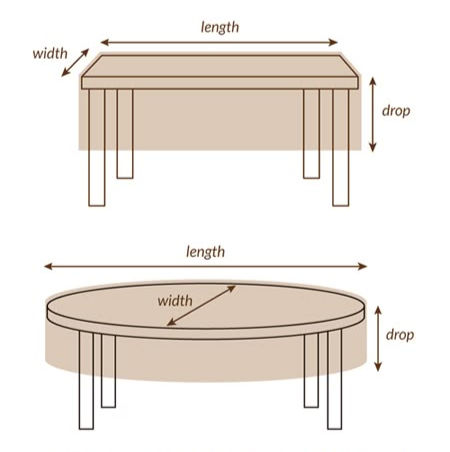
Square table:
Measurement: Measure the length of one side of the table (e.g., L).
Calculation: Tablecloth side length = L + (2 x desired drop).
Example: You have a square table with dimensions 90 x 90 cm.
For an everyday tablecloth (with a 20 cm drop):
Tablecloth length = 90 cm + (2 x 20 cm) = 90 cm + 40 cm = 130 cm.
Therefore, you need a 130 x 130 cm tablecloth.
For a formal tablecloth (with a 75 cm drop to the floor, if the table height is standard ~75 cm):
Tablecloth length = 90 cm + (2 x 75 cm) = 90 cm + 150 cm = 240 cm.
Therefore, you need a 240 x 240 cm tablecloth.
Rectangular table:
Measurement: Measure the table's length (L) and width (W).
Calculation:
Tablecloth length = L + (2 x desired drop)
Tablecloth width = W + (2 x desired drop)
Example: You have a rectangular table with dimensions 180 x 90 cm.
For an everyday tablecloth (with a 20 cm drop):
Tablecloth length = 180 cm + (2 x 20 cm) = 180 cm + 40 cm = 220 cm.
Tablecloth width = 90 cm + (2 x 20 cm) = 90 cm + 40 cm = 130 cm.
Therefore, you need a 220 x 130 cm tablecloth.
For a formal tablecloth (with a 75 cm drop to the floor):
Tablecloth length = 180 cm + (2 x 75 cm) = 180 cm + 150 cm = 330 cm.
Tablecloth width = 90 cm + (2 x 75 cm) = 90 cm + 150 cm = 240 cm.
Therefore, you need a 330 x 240 cm tablecloth.
Round table:
Measurement: Measure the table's diameter (D).
Calculation: Tablecloth diameter = D + (2 x desired drop).
Example: You have a round table with a 120 cm diameter.
For an everyday tablecloth (with a 20 cm drop):
Tablecloth diameter = 120 cm + (2 x 20 cm) = 120 cm + 40 cm = 160 cm.
Therefore, you need a round tablecloth with a 160 cm diameter.
For a formal tablecloth (with a 75 cm drop to the floor):
Tablecloth diameter = 120 cm + (2 x 75 cm) = 120 cm + 150 cm = 270 cm.
Therefore, you need a round tablecloth with a 270 cm diameter.
I hope this article has provided you with valuable insights and practical tips on mastering the fundamentals of table setting. Now you know that by understanding the different types of tables, skillfully calculating seating arrangements, and choosing the perfect size tablecloth, you can create an unforgettable atmosphere at any event. Remember that table setting is an art that combines functionality with aesthetics, and every element plays its role in the overall ambiance.
May your tables always be set with love, hospitality, and beauty, creating warm and unforgettable memories for everyone!


Comments